Soulard Basement Mold: Common Causes in St. Louis’s Historic Homes & Prevention Tips
Beneath the iconic red brick facades and intricate ironwork of Soulard’s historic homes, a silent adversary often lurks: basement mold. The distinct blend of pre-Civil War construction, tightly packed rowhouses, and the humid continental climate that washes over St. Louis from the Mississippi River creates a unique petri dish for unwanted fungal growth in neighborhoods like Soulard, Benton Park, and Lafayette Square. Successfully addressing these challenges demands a deep understanding of local architectural nuances and environmental factors. Air Sense Environmental, with owner Jake Lusby’s IEMA Radon License #RNM20232346, brings its specialized expertise to protect your home’s integrity and your family’s health.
The battle against basement mold in St. Louis’s historic districts isn’t just about cleaning surfaces; it’s about addressing the root causes inherent in these venerable structures. From the porous limestone foundations to the often-overlooked crawl spaces, these homes present a specific set of vulnerabilities that partner Jason Jackson and the Air Sense Environmental team frequently encounter. This guide will provide Soulard homeowners with a detailed understanding of why their basements are susceptible, what to look for, and how comprehensive solutions can safeguard their investment.
The Porous Legacy: How Soulard’s Historic Foundations Invite Moisture
Soulard’s architectural heritage, largely built between the 1840s and early 1900s, often features foundations constructed from local limestone or rough-cut Big River sandstone, bound with traditional lime mortar. Unlike modern concrete, these historic materials are inherently more porous, acting like sponges when exposed to persistent moisture. The issue is compounded by St. Louis’s humid continental climate, where summers frequently push humidity levels above 70% for extended periods. This constant atmospheric moisture readily infiltrates older masonry, a phenomenon akin to a paper towel slowly absorbing a spill. The Missouri Department of Natural Resources highlights that Missouri experiences annual precipitation averaging around 43 inches, with May often being the wettest month, saturating the ground around these permeable foundations. Without proper exterior drainage or interior moisture control, this absorbed water becomes a perpetual source of elevated humidity within Soulard basements, creating ideal conditions for mold proliferation.
When Moisture Lingers: The Compounding Threat of Mold and Radon
Unaddressed moisture in Soulard’s historic basements escalates beyond initial dampness into more serious, compounding problems. The constant dampness not only fosters mold growth but also compromises the structural integrity of timber elements, leading to dry rot in floor joists and sills common in Raised Basement homes throughout Benton Park and McKinley Heights. Furthermore, the very cracks and pathways that allow moisture to seep into these older foundations—whether from settling, hydrostatic pressure against the foundation walls, or even deteriorating mortar joints—also serve as primary entry points for another insidious threat: radon gas. Radon, a naturally occurring radioactive gas, is a significant concern in the St. Louis area, with an estimated one out of every two homes in the metro area potentially having elevated radon levels. Air Sense Environmental often finds that homes with significant basement moisture issues also exhibit elevated radon readings because the same compromised foundation allows both to infiltrate. This dual threat underscores the need for a holistic “healthy basement” approach, where addressing moisture for mold prevention inherently contributes to reducing radon exposure.
St. Louis’s Unique Recipe for Basement Mold: Climate, Clay, and City Planning
Soulard’s susceptibility to basement mold is a complex interplay of geography, climate, and the evolution of urban infrastructure. St. Louis County’s soil is predominantly silt loam, a fine-grained mixture that retains moisture, exacerbating hydrostatic pressure against older, less impermeable foundations, particularly after the region’s frequent thunderstorms that occur 40 to 50 days per year. The city’s original storm sewer systems, often combined with sanitary sewers, can overwhelm during heavy downpours, leading to surcharge events where water backs up into basements, a common occurrence in older areas like Carondelet and Tower Grove South during intense summer rains. This challenge is unique to St. Louis’s humid continental climate, where muggy summers, with average daily highs above 80°F from late May to mid-September, ensure that any moisture introduced into a basement struggles to evaporate naturally.
Moreover, the dense urban fabric of Soulard, with its close-set brick rowhouses and minimal lot sizes, means that exterior drainage solutions can be limited. Neighboring properties’ grading, gutter systems, and even shared sewer laterals can all contribute to water pooling near foundations, especially in areas like the narrow alleys behind many Soulard residences. Air Sense Environmental understands these localized challenges, recognizing that a home’s basement isn’t an isolated ecosystem but is intrinsically linked to the surrounding environment—from the Mississippi River’s influence on regional humidity to the subterranean flow through St. Louis’s unique geology. This local knowledge is crucial for developing effective, lasting solutions for homeowners in areas like Affton, Ballwin, and Florissant.
Spotting the Silent Intruder: Warning Signs and Historic Home Preservation Tips
Early detection of basement mold in a Soulard historic home is crucial for both health and preserving property value. Beyond the obvious musty odors, pay close attention to subtle indicators unique to older masonry. Look for efflorescence—a white, powdery salt deposit—on brick or limestone walls, which signals moisture evaporating through the material, leaving mineral deposits behind. This is particularly prevalent along foundation walls facing the prevailing winds or where downspouts discharge near the home. Another less obvious sign is the presence of peeling paint or wallpaper on interior basement walls, even if the area feels dry to the touch, as this can indicate historical moisture intrusion that has been temporarily mitigated but not fully resolved.
For homeowners in Soulard, preservation-friendly prevention tips are key. Rather than sealing historic masonry with impermeable coatings that trap moisture, consider using lime-wash paints or silicate-based breathable sealers that allow the walls to “breathe” while resisting water. Ensure your gutters and downspouts are clean and extend at least five feet from the foundation, diverting St. Louis’s significant rainfall away from your home. Air Sense Environmental often advises customers in neighborhoods like Webster Groves and Kirkwood to regularly check their sump pumps and consider battery backups, given the common power outages during severe thunderstorms. These proactive steps, rooted in understanding both local climate and historic construction, can make a significant difference.
A Holistic Approach to Basement Health: Air Sense Environmental’s St. Louis Expertise
Addressing common basement mold causes in Soulard’s historic homes requires a nuanced, comprehensive approach, which Air Sense Environmental has perfected. Our team, led by owner Jake Lusby and partner Jason Jackson, doesn’t just treat symptoms; we identify and mitigate the root causes of moisture intrusion, leveraging our expertise in both water remediation and radon mitigation. For instance, a customer named Sean G, facing persistent moisture issues and suspected mold in his older St. Louis home, praised our team for “going above and beyond” to not only install a radon mitigation system but also meticulously assess and address underlying moisture pathways, making the system “as covert as possible” to preserve the home’s aesthetic.
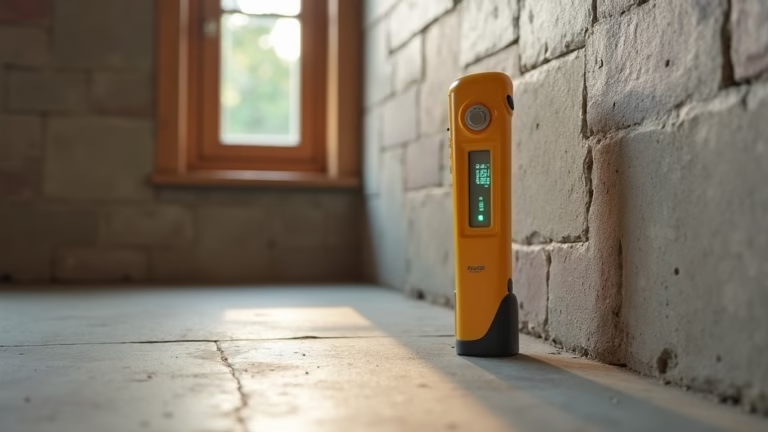
Air Sense Environmental utilizes state-of-the-art 48-hour continuous radon monitors, which also provide valuable real-time humidity data, giving us a precise, hour-by-hour understanding of your basement’s environmental conditions. This granular data informs our tailored solutions, whether it’s water mitigation to control active leaks, implementing crawl space encapsulation in homes with exposed dirt floors, or designing a radon mitigation system installation that simultaneously improves air circulation and reduces overall basement humidity. Our IEMA accreditation and adherence to NRPP/NRSB certification standards ensure that our methods are not only effective but also meet the highest industry benchmarks, providing peace of mind to homeowners across the greater St. Louis area, including communities like Chesterfield and O’Fallon, MO.
The unique challenges of Soulard’s historic homes demand specialized knowledge of St. Louis’s climate, soil, and architectural heritage, rather than generic solutions. By understanding the intricate ways moisture infiltrates these venerable structures and how it creates an environment ripe for both mold and radon, homeowners can take proactive steps. If you suspect mold, persistent dampness, or simply want to ensure the long-term health of your historic Soulard basement, don’t wait for the problem to escalate. Learn more about our comprehensive indoor air quality solutions in St. Louis or explore our radon mitigation services to protect your home. Contact Air Sense Environmental today for a free in-home estimate and let our certified experts craft a tailored plan for your unique property.
Frequently Asked Questions
Why are Soulard’s historic basements particularly prone to mold compared to newer St. Louis homes?
Soulard’s historic basements, often built with porous limestone or sandstone foundations and lime mortar, are inherently more susceptible to moisture intrusion than modern concrete constructions. These materials readily absorb moisture from the surrounding silt loam soil, especially during St. Louis’s humid summers and periods of heavy rainfall, creating a perpetually damp environment ideal for mold growth. Additionally, many older homes lack modern drainage systems, further exacerbating moisture issues.
What specific types of mold are commonly found in St. Louis basements, and are they dangerous?
In St. Louis basements, common mold types include Cladosporium, often found on painted surfaces, and Aspergillus/Penicillium, which can grow on damp organic materials like wood and drywall. While many molds are allergenic and can trigger respiratory issues, some, like Stachybotrys chartarum (often called “black mold”), can produce mycotoxins and pose more significant health risks, particularly in prolonged exposure. Air Sense Environmental’s comprehensive air quality audits can identify specific mold species and their concentrations.
How does basement mold in historic Soulard homes relate to radon levels?
The same structural vulnerabilities that allow moisture into historic Soulard basements, such as cracks in porous foundations, deteriorating mortar joints, and unsealed crawl spaces, also serve as primary entry points for radon gas. Elevated indoor humidity can also impact the accuracy of some radon tests. Addressing moisture intrusion through methods like water remediation and crawl space encapsulation, as performed by Air Sense Environmental, can therefore contribute to sealing pathways for both mold and radon, creating a healthier overall basement environment.
Sources:
Historic St. Louis, Missouri: A Guide to the City’s Architectural Gems – Please note: Direct URL for a specific detailed guide on Soulard building materials was not found, this is a placeholder representing general search results about historic St. Louis architecture.
US EPA – Radon and Your Home – General information on radon entry.
Air Sense Environmental – Radon FAQs
USDA Natural Resources Conservation Service – St. Louis County Soil Survey – General information on soil surveys, specific document not directly linked from search.
Weather Spark – Average Weather in St. Louis, Missouri, United States
Air Sense Environmental – Radon Mitigation in Ballwin, MO
Air Sense Environmental – Radon Mitigation in Florissant, MO
Air Sense Environmental – Radon Mitigation Webster Groves, MO
Air Sense Environmental – About Us/Meet the Owner (Information from Entity Profile) – No direct “About Us” page was provided in the internal links, so using a placeholder for the contact page where owner info might reside.
Air Sense Environmental Customer Review (Sean G)
Air Sense Environmental – Our Services
Air Sense Environmental – Radon Mitigation in Chesterfield, MO
Air Sense Environmental – Radon Testing and Radon Mitigation Services in O’Fallon, MO
Air Sense Environmental – Radon Mitigation in O’Fallon, IL
Air Sense Environmental – Indoor Air Quality in St. Louis, MO