Webster Groves’ Hidden Threat: Why Historic St. Louis Homes Are Mold Magnets
The charming, tree-lined streets of Webster Groves, with their distinctive Queen Anne, Craftsman, and Federal-style residences, evoke a timeless sense of grandeur unique to St. Louis. Yet, beneath the ornate gables and sturdy brickwork of these beloved homes—and those in neighboring Kirkwood and Lafayette Square—often lies a silent, pervasive threat: mold. The unique confluence of St. Louis’s climate, geology, and aging infrastructure creates an environment where mold doesn’t just appear; it flourishes. Understanding this local reality is precisely where experts like Air Sense Environmental, with their deep roots in St. Louis indoor air quality, offer indispensable insight.
For homeowners across the metro area, from the historic brick homes of Soulard to the stately residences of Central West End, the battle against unseen invaders like mold is a continuous one. Jason Jackson, a Partner at Air Sense Environmental, has witnessed firsthand how St. Louis’s specific environmental challenges contribute to persistent moisture issues that historic homes are particularly vulnerable to. This article will unravel the complex web of factors that make these architectural treasures susceptible to mold, providing you with a deeper understanding of the hidden threats and effective solutions.
St. Louis’s Humid Embrace: The Science Behind Persistent Moisture
St. Louis experiences a humid continental climate, characterized by significant temperature and humidity swings that are far from ideal for maintaining a mold-free indoor environment. Summers here are notoriously hot and muggy, with average high temperatures reaching 89°F in July, often accompanied by relative humidity levels soaring between 70-90%. This isn’t just a discomfort; it’s a critical factor in understanding mold problems in historic St. Louis homes. Even during the cooler months, the average humidity across St. Louis hovers around 69% year-round. Mold spores, which are microscopic and ubiquitous in the environment, require only three things to thrive: moisture, a food source (like wood, drywall, or fabric), and a suitable temperature. St. Louis’s climate consistently provides the first two in abundance.
Imagine your home’s interior as a large, porous sponge. When outdoor humidity saturates the air, this moisture is constantly seeking equilibrium, naturally migrating indoors through cracks, porous foundations, and even seemingly impermeable building materials. With annual precipitation just under 34 inches, and spring months like March through May being the wettest, historic homes are often battling an uphill struggle against relentless moisture intrusion. This sustained dampness, particularly when indoor humidity levels exceed 65%, creates an ideal breeding ground for mold to colonize and spread rapidly.
Beyond the Visible: How Historic Construction Fuels Hidden Mold Growth
The very charm of old house mold St. Louis properties often lies in their original construction methods and materials, which unfortunately, also make them exceptionally prone to mold. Many homes in Webster Groves, built between the mid-1800s and the 1920s, feature thick stone foundations, plaster walls, and wooden center beams. Unlike modern construction with its reliance on vapor barriers and advanced waterproofing, these older structures were designed to “breathe.” While this was beneficial in an era before central air conditioning, it means they readily absorb and retain moisture from the humid St. Louis air and surrounding soil.
Consider the common basement in a historic home in neighborhoods like Benton Park or Compton Hill. Often built with limestone or brick, these foundations can wick moisture directly from the earth, creating perpetually damp environments. This isn’t always obvious; visible water might be absent, but the constant presence of elevated humidity behind plaster or paneling allows mold to flourish unseen. Furthermore, aging infrastructure, including old plumbing lines and original roofing systems that have seen decades of St. Louis’s frequent thunderstorms and over 18 inches of annual snowfall, can develop slow, insidious leaks. These leaks often go undetected for extended periods, saturating wooden framing or insulation within wall cavities, providing a perfect, dark, and damp habitat for mold. Air Sense Environmental’s comprehensive air quality audits are specifically designed to penetrate these hidden areas, utilizing advanced technology like the Model 5200 IAQ Monitor to detect the invisible signs of moisture and mold growth before they become widespread structural or health hazards.
The St. Louis Undercurrent: Geologic and Atmospheric Pressures
The unique geology and atmospheric patterns of the St. Louis metropolitan area further exacerbate mold challenges in its historic housing stock. St. Louis County soil is predominantly silt loam, comprising 61.7% silt and 19.1% clay. This composition, while fertile, places it in hydrologic group C, indicating a moderate-high runoff potential during heavy rains. What does this mean for homeowners in areas like University City or Affton? It means that when spring storms roll through, bringing just under 10.5 inches of rain from March to May, the soil’s capacity to absorb water is limited. Water tends to pool around foundations, increasing hydrostatic pressure and the likelihood of moisture intrusion into basements and crawl spaces.
The region’s intense seasonal changes also play a significant role in St. Louis humid climate mold. The transition from hot, muggy summers to cold, snowy winters creates repeated cycles of expansion and contraction in building materials, leading to cracks in foundations, mortar joints, and roofing. These tiny fissures become pathways for moisture. For instance, in September 2025, St. Louis recorded an alarming 139,869 mold spores per cubic meter of air, one of the highest counts ever measured, directly linked to recent rainfall followed by warm temperatures creating ideal conditions for mold to flourish on decaying vegetation. This seasonal spike means homes are constantly bombarded by airborne spores, ready to colonize any damp surface indoors.
Moreover, while the City of St. Louis adopted the 2018 International Building Code and Property Maintenance Code, many historic homes in neighborhoods like Shaw, Dutchtown, or the Central West End predate these modern standards by decades, if not a century. Original construction practices, while robust for their time, simply weren’t designed to combat the persistent moisture challenges intensified by today’s climate patterns. This means homeowners often face the dual challenge of preserving historic integrity while also retrofitting properties to meet contemporary moisture control needs, a task where St. Louis mold regulations become a nuanced consideration, particularly when dealing with restoration.
Decoding Your Historic Home: Subtle Signals of Mold Activity
Recognizing mold in its early stages, especially in an old house mold St. Louis, requires a keen eye and an understanding of specific indicators beyond just visible growth. The subtle signals often appear first, particularly in areas like historic basements in Webster Groves or the brick homes of St. Louis Hills. One of the most common, yet often overlooked, signs is a persistent, musty odor, reminiscent of damp earth or decaying leaves. This smell is a strong indicator of microbial volatile organic compounds (MVOCs) released by actively growing mold, even if it’s hidden behind walls or under flooring.
Homeowners should also watch for condensation on windows, especially during the dramatic temperature and humidity shifts characteristic of St. Louis. Excessive condensation, when combined with poor ventilation, can lead to moisture accumulation on window sills and adjacent wall surfaces, creating a perfect localized environment for mold. Peeling paint or wallpaper, particularly in basements, bathrooms, or near exterior walls, often points to underlying moisture issues rather than just old age. Darkened grout lines in tiled areas, or slight discoloration on drywall that isn’t easily wiped away, can also be early signs. Air Sense Environmental’s team frequently encounters these subtle cues when performing Webster Groves mold inspection and indoor air quality assessments in areas like Kirkwood and Florissant, helping homeowners address the root cause before the problem escalates.
Air Sense Environmental’s Proactive Approach to St. Louis Mold Challenges
Addressing the complex nature of mold problems in historic St. Louis homes requires more than a quick fix; it demands a comprehensive, expert-driven strategy. Air Sense Environmental, established in November 2023, stands as a beacon of authority in indoor environmental quality across the St. Louis metropolitan area. Our approach goes beyond surface-level solutions, focusing on identifying the source of moisture intrusion and implementing lasting remediation.
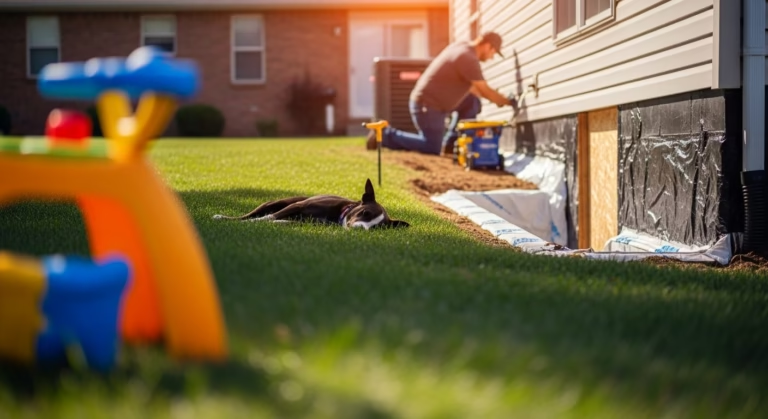
Our team employs state-of-the-art diagnostic tools, including the advanced Model 5200 IAQ Monitor, for precise Indoor Air Quality Audits. This technology allows us to measure dust, particles, chemical pollutants, carbon dioxide, and crucially, humidity levels in real-time, providing a scientific, data-driven picture of your home’s environment. When dealing with the challenges of preventing mold in historic basements, our expertise in crawl space encapsulation is invaluable. We install robust vapor barriers, seal vents, add insulation, and strategically deploy AprilAire dehumidifiers to transform damp, mold-prone crawl spaces into dry, healthy environments. This not only mitigates existing mold risks but also significantly improves overall indoor air quality by preventing musty, contaminated air from circulating into your living spaces.
Our commitment to excellence is reflected in our team’s credentials. Jake Lusby, for instance, holds an IEMA Radon License (#RNM20232346), demonstrating our adherence to rigorous industry standards. While our core expertise is radon mitigation, the principles of controlling indoor air quality, managing moisture, and sealing environmental intrusions are directly applicable and crucial for mold prevention. We recently worked with a customer in Florissant who was experiencing persistent musty odors and suspected mold, despite no visible signs. Our team’s thorough inspection and use of advanced moisture detection not only pinpointed a hidden moisture source in their historic basement but also allowed us to implement a targeted crawl space solution, reducing humidity and eliminating the odor. Our dedication to clear communication, efficient scheduling, and going above and beyond to make systems as discreet as possible, as frequently highlighted in our 5-star customer reviews, ensures homeowners receive not just a service, but peace of mind. We pride ourselves on quick response and scheduling, aiming to fit customers in within one week for installations, ensuring timely intervention for critical moisture issues.
Safeguarding St. Louis’s Historic Charms from Mold
The timeless appeal of historic St. Louis homes, particularly in cherished areas like Webster Groves, comes with a unique set of challenges. The interplay of our region’s humid climate, specific soil characteristics, and the inherent nature of older construction makes them susceptible to persistent moisture and, consequently, mold. Understanding these local nuances is the first step toward effective prevention and remediation.
Whether you’re contending with the tell-tale musty odor in your historic Lafayette Square basement, or concerned about the humidity levels in your Webster Groves crawl space, proactive measures are essential. Air Sense Environmental offers specialized services from water damage restoration in St. Louis to expert crawl space encapsulation and comprehensive radon mitigation system installation that inherently addresses the environmental conditions conducive to mold growth. Don’t let the charm of your historic St. Louis home be overshadowed by hidden threats. Contact Air Sense Environmental today for a consultation to ensure your cherished property remains a healthy and safe sanctuary.
Frequently Asked Questions
How does St. Louis’s humid climate specifically impact mold growth in historic homes?
St. Louis’s humid continental climate, with average July highs of 89°F and relative humidity often between 70-90%, creates an ideal environment for mold. This sustained moisture, combined with the “breathing” nature of older construction materials like plaster and stone, allows mold spores—which are always present—to rapidly germinate and spread, particularly when indoor humidity exceeds 65%.
What are the common hidden areas for mold in older St. Louis homes, especially in basements?
In historic St. Louis homes, especially in neighborhoods like Soulard or Webster Groves, mold frequently hides behind plaster walls, under old linoleum or carpet, inside wall cavities, and within the porous stone or brick foundations of basements and crawl spaces. These areas often experience consistent moisture wicking from the silt loam soil, which has a moderate-high runoff potential during St. Louis’s frequent heavy rains.
Are there specific building code considerations for mold remediation in historic St. Louis properties?
While Missouri does not license home inspectors, the City of St. Louis adopted the 2018 International Property Maintenance Code, which addresses issues like moisture intrusion and structural integrity that are relevant to mold. For historic properties, any remediation or renovation work might also need to consider guidelines from the Webster Groves Historic Preservation Commission to ensure changes are aesthetically appropriate and preserve the home’s character.