Preserving Edwardsville’s Past: Crawl Space Encapsulation for Historic Home Moisture Control and IAQ
Edwardsville, Illinois, with its storied architecture lining the brick streets of the Downtown Historic District and the charming bungalows of Leclaire, offers a unique window into Illinois’s rich past. Yet, these treasured homes, many dating back to the 1800s, face distinct challenges from the humid continental climate, especially where the unseen foundations meet the dynamic Illinois soil. For homeowners in Leclaire, the Brick Street District, or even the established residences around Southern Illinois University Edwardsville (SIUE), managing moisture and ensuring healthy indoor air quality (IAQ) in these older properties requires a specialized approach. Air Sense Environmental, an IEMA-accredited environmental inspection and mitigation expert, understands the delicate balance between preserving historical integrity and implementing modern solutions for a healthy home.
Historic Construction Meets Modern Moisture Science
Connecting Edwardsville’s past with its present requires a keen understanding of both historical construction and contemporary environmental science. The team at Air Sense Environmental, including Partner Jason Jackson, has firsthand experience with the unique moisture profiles of Edwardsville’s diverse housing stock. This article will delve into why crawl space encapsulation is not just a modern amenity but a critical preservation tool for Edwardsville’s historic homes, revealing how it safeguards structural integrity and enhances indoor air quality without compromising the architectural legacy of properties across areas like the City Center and Country Club Manors.
The Silent Threat: How Humidity Undermines Historic Foundations
The very charm of Edwardsville’s historic homes often lies in their original construction, utilizing materials like rough-hewn stone, local brick, and lime-based mortars. Unlike modern poured concrete, these traditional foundations possess a more porous structure. This inherent characteristic, while historically sound, makes them particularly susceptible to the pervasive moisture Edwardsville experiences. The city’s humid continental climate means hot, muggy summers where perceived humidity can be “muggy, oppressive, or miserable at least 18% of the time” from May to September, with July experiencing an average of 21.3 muggy days. Even in winter, January boasts a very high average relative humidity of 86%.
The Crawl Space as a Sponge
Imagine your historic home’s crawl space as a giant sponge constantly exposed to this fluctuating humidity. The porous brick or stone of a foundation, common in homes built before the 1940s, acts like a wick, drawing moisture from the surrounding soil into the structural elements above. This process is exacerbated by Edwardsville’s annual average of 43-45 inches of rain, making it wetter than most places in Illinois, with May typically being the rainiest month. Without a robust barrier, this constant capillary action saturates wood joists, sill plates, and subflooring, creating an ideal breeding ground for mold and mildew. Air Sense Environmental’s approach to
crawl space encapsulation addresses this fundamental vulnerability by creating an impermeable seal, effectively removing the “sponge” from the equation and creating a dry, stable environment beneath the home.
Compounding Problems in Edwardsville’s Older Homes
Left unaddressed, chronic crawl space moisture transforms from a nuisance into a significant threat, escalating problems far beyond mere musty odors. In Edwardsville’s older homes, particularly those in the St. Louis Street District or Holiday Shores with their diverse architectural styles from the 1880s and ’90s, these issues compound. The constant dampness attacks original wood framing, leading to rot and compromising the structural integrity of floor joists and subflooring. This isn’t just about superficial damage; it can manifest as uneven floors, sticking doors, and cracks in interior plaster walls-subtle shifts that betray deeper, unseen foundational distress.
The Builder’s Trench Problem
Furthermore, the “builder’s trench” often left around exterior foundation walls in historic construction can become a reservoir for damp materials if not properly backfilled, intensifying moisture problems against masonry walls. This continuous saturation creates an environment where destructive pests like termites thrive, drawn to softened wood. A less obvious, yet critical, consequence is the potential for elevated radon levels. Edwardsville’s water supply is drawn from deep aquifers passing through extensive limestone bedrock formations, a natural source of radon [Grounding Data]. In older homes with their more natural ventilation patterns and sometimes less-sealed foundations, the “stack effect” can draw radon gas from the soil into the crawl space and then upward into living areas. Air Sense Environmental, with its expertise in
radon mitigation system installation and advanced radon testing equipment, is uniquely equipped to identify and address this dual threat, ensuring comprehensive protection for Edwardsville’s historic properties.
Edwardsville’s Unique Challenges: Climate, Geology, and Historic Preservation
Preserving Edwardsville’s past demands an understanding of its distinct environmental and regulatory landscape. Beyond the general midwestern humidity, Edwardsville’s specific climate data reveals year-round moisture challenges. The average annual humidity hovers around 69%, creating a persistent battle against dampness. This is compounded by Edwardsville’s position, experiencing distinct freeze-thaw cycles during its very cold winters where temperatures can drop to a January low of 22°F. These cycles place immense stress on older, more brittle foundations, potentially exacerbating existing cracks and pathways for moisture intrusion.
Limestone Bedrock and Hard Water
Geologically, the limestone bedrock beneath Edwardsville, while a source for its notoriously “very hard” water (reaching 430 ppm total dissolved solids and earning a “D” grade for health guideline compliance due to contaminants like radium) [Grounding Data], also contributes to the local radon potential. For historic homes in neighborhoods like Bluff Junction or Stone Meadows, understanding this subterranean reality is crucial for effective indoor air quality management.
Historic District Review for Exterior Work
Crucially, any significant exterior work on Edwardsville’s 44 designated historic landmarks or properties within its four historic districts-including the Leclaire, Brick Street, and St. Louis Street Districts-requires a Certificate of Appropriateness (COA) from the Edwardsville Historic Preservation Commission (HPC). These guidelines, based on the
Secretary of the Interior’s Standards for Rehabilitation, stress preserving original materials and differentiating new work from old. This means a crawl space encapsulation project in the historic homes of Downtown Edwardsville or Pinebrook Estates must be executed with a nuanced understanding of these preservation principles. The City of Edwardsville has adopted the 2021 International Residential Code with amendments, which includes specific requirements for vapor barriers and ventilation in crawl spaces, demanding that modern solutions integrate seamlessly with historic structures without causing irreversible alterations. Air Sense Environmental’s local knowledge, extending to areas like Enclave and Country Club Manors, ensures compliance and respect for Edwardsville’s architectural heritage.
Recognizing the Early Warning Signs in Edwardsville’s Historic Homes
Homeowners of Edwardsville’s cherished older properties, from the charming cottages in Leclaire to the more substantial residences near Downtown, can become the first line of defense against crawl space moisture. Unlike newer constructions, historic homes often telegraph their distress through subtle, yet telling, indicators. Pay close attention to persistent musty odors, particularly a damp, earthy smell emanating from the floor registers or basement access points-a scent often intensified in Edwardsville’s muggy summer months. This isn’t just an “old house smell”; it’s a clear signal of microbial growth in the crawl space.
Inspecting Wood in the Crawl Space
Visually inspect any exposed wooden elements in your crawl space, such as floor joists, support beams, or subflooring. Look for darkened wood, powdery residue, or softness when probed, which are tell-tale signs of wood rot or fungal decay. On historic brick or stone foundations, keep an eye out for efflorescence-a white, powdery mineral deposit on the surface, indicating moisture migrating through the masonry. If you’ve noticed an uptick in pests like carpenter ants, termites, or even rodents, it could be a sign that a damp crawl space is providing an inviting habitat. Jason Jackson, Partner at Air Sense Environmental, often points out how Edwardsville’s plentiful rainfall, particularly during the wet spring months, can quickly expose these vulnerabilities in older foundations. Even changes in your home’s energy bills without a clear explanation could suggest that conditioned air is escaping through a compromised crawl space, or humid air is making your HVAC work harder.
Air Sense Environmental: Tailored Encapsulation for Edwardsville’s Heritage
At Air Sense Environmental, addressing crawl space issues in Edwardsville’s historic homes is more than just a service; it’s a commitment to preserving the community’s architectural legacy. We understand that a cookie-cutter approach simply won’t suffice for properties that have stood for a century or more. Our methodology for
crawl space encapsulation begins with a comprehensive, free in-home estimate, assessing the unique construction and moisture profile of each Edwardsville property.
Customized Plans From Jake Lusby’s Team
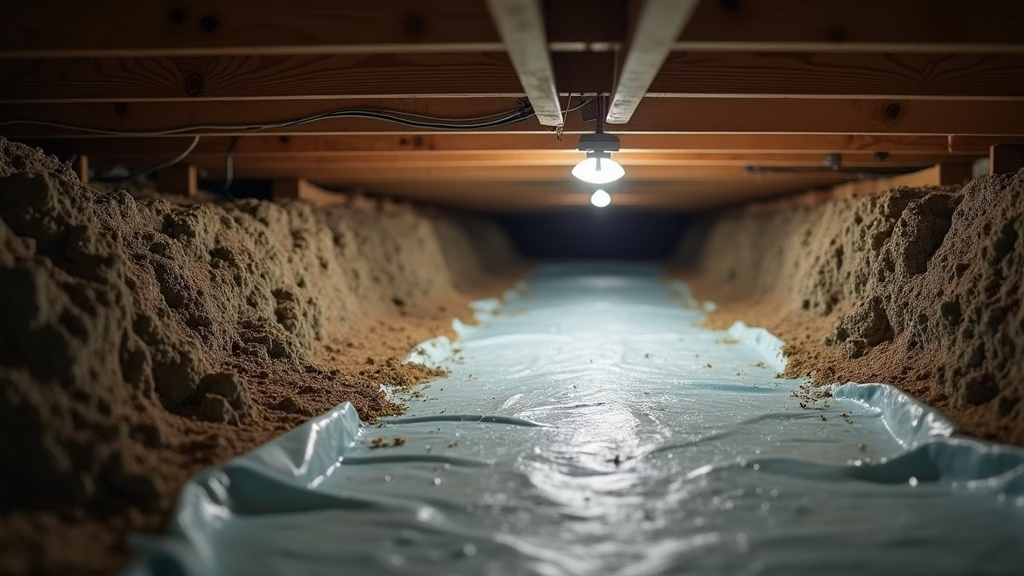
Our team, including experts like Jake Lusby, specializes in crafting customized mitigation plans that respect the integrity of historic foundations while delivering superior moisture control and indoor air quality improvements. We utilize a high-durability vapor barrier system, expertly installed over the exposed soil and sealed to the foundation walls. Crucially, in many of Edwardsville’s older homes, we integrate this with sub-slab suction, a technique often associated with
radon mitigation, directly beneath the vapor barrier. This dual-purpose system not only prevents ground moisture from entering the crawl space but also actively removes any lingering soil gases, including radon, making it especially effective for homes built over Edwardsville’s limestone bedrock.
A 1910 Leclaire Bungalow Example
For a historic home in the Leclaire neighborhood, for example, a recent project involved a 1910 Craftsman bungalow with a damp brick crawl space. Our team meticulously installed the vapor barrier, paying close attention to sealing around original piers and ensuring the system could be serviced without compromising the historic fabric. We also deployed our state-of-the-art continuous radon monitors, which provide real-time data throughout a 48-hour test period, offering more accurate results than traditional charcoal tests [Grounding Data]. This precision allowed us to confirm the effectiveness of our integrated encapsulation and mitigation strategy. As an IEMA-accredited contractor, Air Sense Environmental is certified for both radon testing and mitigation, ensuring that our solutions meet the highest industry standards. Our commitment to ongoing maintenance support and educating homeowners, as highlighted in press releases, sets us apart-we’re not just fixing problems; we’re providing lasting solutions with durable materials and meticulous attention to detail, all delivered by friendly, knowledgeable staff like Kate, who ensures clear communication throughout the process. Our quick response and scheduling ensure that Edwardsville homeowners don’t have to wait to protect their most valuable asset.
Safeguarding Edwardsville’s Historic Homes for Future Generations
The unique character of Edwardsville’s historic homes, from the venerable Federal-style brick houses to the Queen Anne and Colonial Revival gems, is a testament to the city’s enduring legacy. Protecting these properties from the insidious effects of moisture and ensuring optimal indoor air quality is a vital act of preservation. By understanding the specific challenges posed by Edwardsville’s humid climate, underlying geology, and historic construction methods, homeowners can take proactive steps to safeguard their investments.
Long-Term Protection Through Encapsulation
Crawl space encapsulation, when executed with the specialized knowledge and precision that Air Sense Environmental provides, offers a comprehensive solution. It’s an investment that not only enhances comfort and energy efficiency but fundamentally protects the structural integrity and historical authenticity of these irreplaceable homes. For a thorough assessment of your Edwardsville historic home’s crawl space needs, including integrated radon and moisture solutions, explore our
indoor air quality services or learn more about
radon testing in Edwardsville.
Frequently Asked Questions
Does crawl space encapsulation in Edwardsville historic homes require special permits or approvals?
Yes, for homes designated as historic landmarks or located within one of Edwardsville’s historic districts (like Leclaire, Brick Street, or St. Louis Street), any exterior work, including aspects of crawl space encapsulation that might affect the visible exterior, requires a Certificate of Appropriateness (COA) from the Edwardsville Historic Preservation Commission (HPC). It’s crucial to consult with the Edwardsville Public Works Department early in your planning to understand the specific requirements and ensure compliance with preservation guidelines.
What are the specific risks of high humidity in Edwardsville’s climate for older home foundations?
Edwardsville’s climate presents year-round humidity challenges, with an average annual humidity of 69% and notably muggy summers where July can see over 21 days of uncomfortable humidity. This high and fluctuating moisture content significantly increases the risk of wood rot in structural components like joists and subflooring, accelerates the deterioration of porous historic foundation materials such as stone and lime mortar, and creates an ideal environment for mold and mildew growth. These issues compromise structural integrity and indoor air quality.
How does crawl space encapsulation specifically address radon concerns in Edwardsville’s historic homes?
Edwardsville’s geology, with its deep aquifers passing through limestone bedrock, means radon gas is a significant concern [Grounding Data]. Historic homes often have less sealed foundations or natural ventilation patterns that can draw radon from the soil into the crawl space and then into living areas. Air Sense Environmental’s encapsulation process, especially when combined with sub-slab suction beneath the vapor barrier, actively mitigates radon by creating a depressurization zone that safely vents the gas outside, offering a comprehensive solution for both moisture and
radon concerns in Edwardsville, IL.