
How Much Does Radon Mitigation Cost in St. Louis?
Radon mitigation cost in St. Louis is set by three things: the foundation type, the number of suction points the sub-slab needs, and the fan size, which is why Air Sense Environmental quotes every system after a free in-home assessment rather than from a price list. Radon mitigation cost in St. Louis is typically $1,100 to $3,200 for an active sub-slab depressurization system, which is the most common design for homes in St. Louis, MO, St. Louis County and St. Charles County. Wall-based systems run about $500 to $3,000, passive systems $500 to $2,500, and crawl space mitigation $500 to $5,000, so the foundation type drives the price more than anything else. The national average for a radon mitigation system is $1,300 to $1,600. The sections below break down each system type, every factor that moves the number, what the system costs to run, and how to compare quotes.
For how the system itself is designed, installed and verified, see our radon mitigation in St. Louis service page. If you have not tested yet, start with radon testing: the EPA action level is 4.0 pCi/L, and a system is only worth pricing once a test shows your home is at or above it.
Understanding Radon and Its Risks
Radon is a naturally occurring, radioactive gas that comes from the breakdown of uranium in soil, rock, and water. It seeps into homes through cracks in the foundation, sump pits, floor drains and other openings. You cannot see, smell, or taste it. The EPA lists radon as the second leading cause of lung cancer in the United States, and recommends that any home reading at or above 4.0 pCi/L be mitigated. Testing your home is the only way to know where you stand. If levels are high, an active mitigation system is the most effective way to bring them down and keep them down.
Radon Mitigation Cost by Type of System
Many homeowners ask, “How much does a radon mitigation system cost based on the type of system I need?” The answer depends on your home’s construction, because the system has to match the foundation it sits on.
Active Sub-Slab Depressurization ($1,100 to $3,200)
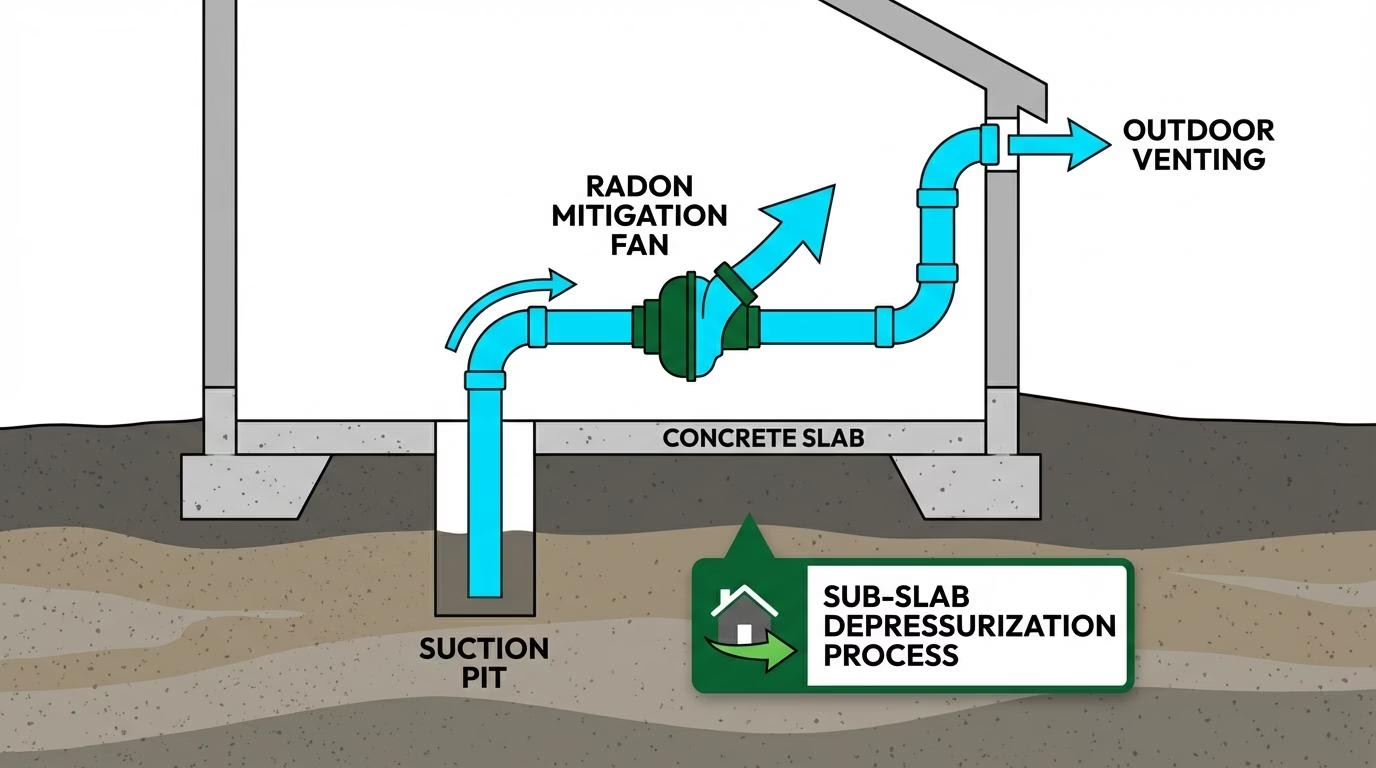
Active sub-slab depressurization is the most common and most effective method for St. Louis homes. A suction pit is cored through the basement or slab floor, a PVC riser connects it to a continuously running radon fan, and the fan exhausts soil gas above the roofline before it can enter the house. Our sub-slab depressurization page walks through the design in detail.
Wall-Based Depressurization Systems ($500 to $3,000)
Wall-based systems draw soil gas out of hollow block foundation walls instead of, or in addition to, the sub-slab. They are common in older St. Louis homes with block foundations, where radon travels through the block cores.
Passive Depressurization ($500 to $2,500)
A passive system uses the same pipe route as an active system but no fan, relying on natural pressure differences to move soil gas. It is not effective at high radon levels. Illinois requires a passive rough-in in all new construction, and a passive pipe in a newer home is good news for the budget: activating it with a fan is a much smaller job than installing a system from scratch.
Crawl Space Mitigation Systems ($500 to $5,000)
A crawl space has no concrete lid to hold a vacuum, so the exposed soil must be sealed first. That means crawl space encapsulation with a heavy vapor barrier, sealed at least 12 inches up the foundation walls, and then a fan and exhaust pipe that depressurize the space under the membrane. Because the barrier is priced by the square foot and the work is done on hands and knees, crawl spaces sit at the top of the cost range.
What Moves a St. Louis Radon Mitigation Quote Up or Down
Within each system type, the final number comes from the house. These are the variables our technicians measure during the free in-home assessment.
Foundation Type and Soil Under the Slab
- Foundation combination. A split-level or a home with an addition often has two separate foundation footprints that are not connected under the soil. Each may need its own suction point, which means more pipe, more labor, and sometimes a second fan.
- Soil permeability. Dense clay under much of the St. Louis metro resists airflow. Poor sub-slab communication means more suction points or a stronger fan to reach the whole footprint.
- Age of the home. Historic homes in South City, Webster Groves and Kirkwood often have thick or layered foundations and compacted fill under the slab that slow the coring and pit work. Newer subdivisions in Chesterfield and St. Charles County frequently have clean gravel beds and, in Illinois, a passive rough-in already in place.
- Crawl space condition. An unsealed crawl space adds encapsulation to the scope, which is the single biggest price step in residential radon work.
Suction Points and Fan Size
A standard basement usually needs one suction point and a mid-range fan. When a pressure field test shows the vacuum is not reaching the far corners of the slab, a second pit or a higher-flow fan is added. Each additional suction point adds coring, piping and labor; a high-static fan costs more than a standard model but is the difference between a system that works and one that does not.
Pipe Routing: Exterior vs. Interior
Exterior routing runs the riser up the outside of the house and is the faster, lower-cost option, at the price of a visible pipe and a fan exposed to Missouri weather. Interior routing takes the pipe through closets and the attic to exit at the roof, which hides the system and protects the fan but takes more labor and planning. Air Sense Environmental quotes both where the house allows it.
Sealing, Sump Pits and Extras
Sealing slab cracks, floor drains and the sump pit is part of a proper install and is included in our quotes. A sealed sump cover, a continuous radon monitor, or a dedicated electrical circuit for the fan can add to the total, and a written quote should list each one so you can see exactly what you are paying for.
What a Radon Mitigation System Costs to Run
The install is the large number. After that, a system has three predictable costs over its life:
- Electricity. The fan runs 24 hours a day and draws about as much power as a 60-watt bulb. Expect roughly $4 to $12 a month depending on the fan model and your kilowatt-hour rate.
- Fan replacement. The fan is the only moving part. Quality radon fans last 10 to 15 years; a radon fan replacement typically runs $300 to $600 installed.
- Retesting. The EPA recommends retesting every two years, and after any renovation that changes the foundation or airflow, such as finishing a basement. See our radon testing cost guide for current prices. The system’s manometer only shows that the fan is pulling; a test shows that the radon level is actually below 4.0 pCi/L.
Our radon system maintenance page covers what to watch between tests.
Professional Installation vs. DIY
DIY radon kits cost roughly $500 to $700, which looks like a saving against a professional install. The gap closes quickly. Without a micromanometer and a pressure field test, a homeowner cannot tell whether the fan is too weak to clear the slab or so strong that it pulls conditioned air out of the house and drives up heating and cooling bills. The EPA also warns that an improperly designed system can backdraft a furnace or water heater. Correcting a failed DIY install usually means starting over.
Missouri does not license radon contractors at the state level, so anyone can call themselves a radon professional there. Illinois does, through IEMA. Air Sense Environmental holds IEMA license #RNM20232346 and NRPP certification, which is what lenders, relocation companies and buyers’ inspectors in the St. Louis area look for when a system is part of a real estate transaction. A professional install also comes with a post-mitigation test and a written guarantee, neither of which a kit can provide.
How to Compare Radon Mitigation Quotes
A low number is only a good deal if the scope is complete. Every written quote should spell out:
- The system type and the planned pipe route.
- The fan model and the pipe specification (Schedule 40 PVC is the standard).
- Whether a licensed electrician and a dedicated circuit are included.
- Who pulls and pays for any municipal permit.
- Sealing of cracks, drains and the sump pit.
- A post-mitigation test.
- A written performance guarantee to bring the home below 4.0 pCi/L.
Red flags in a low bid are the same items missing: no permit, an unnamed fan, thin-wall pipe, no sealing, no follow-up test, or a system routed for the installer’s convenience rather than yours. Our guide to radon mitigation companies in St. Louis covers the credential checks in more detail.
Insurance, Warranties and Resale Value
Is radon mitigation covered by homeowners insurance?
Usually no. Standard policies cover sudden, accidental damage, and insurers treat radon as a naturally occurring condition and mitigation as a home improvement. Confirm with your agent, but plan to pay out of pocket.
What warranty should come with the system?
Fan manufacturers typically warrant the fan for three to five years. The more important promise is the performance guarantee. Air Sense Environmental systems are designed to bring the home below the EPA action level of 4.0 pCi/L, and if a follow-up test ever comes back high we adjust the system at no charge: a bigger fan, a second suction point, or additional sealing, whatever the house needs. Ask any contractor whether the guarantee transfers to a new owner and get it in writing.
Does a radon system help when you sell?
Radon testing is a standard part of due diligence in St. Louis area home sales. A professionally installed system with a certification sticker on the riser and a recent clearance test removes a common inspection contingency, and buyers generally see it as one less project. In neighborhoods where radon is a known issue, a house with a system is often preferred over one without.
Radon and Moisture: One System, Two Benefits
St. Louis basements sit on clay-heavy soil and are prone to dampness. An active sub-slab system pulls moisture-laden soil gas out from under the slab along with the radon, and by reducing the stack effect it often leaves the basement noticeably drier. Where the moisture problem is larger than that, our encapsulation and indoor air quality services address it directly.
Why Choose Air Sense Environmental?
Air Sense Environmental is a St. Louis radon mitigation and testing company headquartered in Edwardsville, Illinois, with crews in Missouri and Illinois every week. Our licensed technicians use diagnostic pressure field testing to design each system for the house it goes into, install most residential systems in a single day, and verify every one with a post-mitigation test. You get a written estimate before any work starts, a written guarantee after it, and a straight answer at every step in between.
Get a Free Radon Mitigation Estimate
Frequently Asked Questions About Radon Mitigation Cost in St. Louis
How much does radon mitigation cost in St. Louis?
Most St. Louis homes need an active sub-slab depressurization system, which runs $1,100 to $3,200 installed. Crawl space homes can run higher because the soil has to be encapsulated first. Air Sense Environmental gives a free written estimate for your specific house.
How long does installation take?
Most standard residential radon mitigation systems are installed in a single day, usually in three to five hours. Multi-foundation homes and interior pipe routes can take longer. See what a radon mitigation system installation day looks like.
How much does a radon fan cost to run?
About as much as a 60-watt bulb left on, or roughly $4 to $12 a month depending on the fan and your electricity rate.
How often should I test for radon after mitigation?
The EPA recommends retesting every two years even with a system in place, and after any renovation that changes the foundation or airflow, to confirm the home is still below 4.0 pCi/L.
Does homeowners insurance cover radon mitigation?
Standard homeowners policies almost never do, because radon is classified as a naturally occurring condition rather than sudden damage.
What warranty comes with a professionally installed system?
Typically a three to five year manufacturer warranty on the fan plus a performance guarantee from the installer. Air Sense Environmental adjusts any system at no charge if a follow-up test comes back above 4.0 pCi/L.
Is a radon system noisy?
Modern radon fans are quiet. You may hear a slight hum or moving air near the fan, but it is generally unobtrusive, and an exterior or attic fan location keeps it out of living spaces.
Is it hard to sell a house with a radon mitigation system?
No. A working system with a recent clearance test usually makes a sale easier by removing a common inspection contingency.