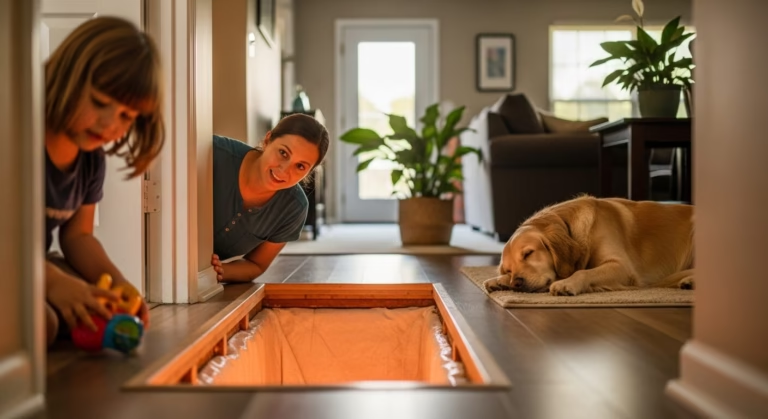
Radon is a colorless, odorless radioactive gas that forms naturally from the decay of uranium in soil and rock beneath your home. It seeps through foundation cracks, slab joints, and utility penetrations, accumulating silently in basements, crawl spaces, and lower living areas where families spend time every day. The EPA estimates radon causes approximately 21,000 lung cancer deaths in the United States each year, making it the second leading cause of lung cancer after smoking. In Missouri and the greater St. Louis metro, elevated radon levels are a documented regional concern, homes across St. Louis City and County, St. Charles, Jefferson, Franklin, Madison, and St. Clair counties all sit in geological zones where testing is strongly recommended.
Air Sense Environmental is St. Louis’s NRPP-certified and IEMA-licensed radon mitigation contractor, serving homeowners, real estate buyers, and property managers throughout the region with the expertise and credentials to get your air safe, and keep it that way.
What Does a Radon Mitigation Contractor Do?
A licensed radon mitigation contractor assesses your home’s radon levels, identifies the source and pathway of radon entry, designs a mitigation system matched to your foundation type, installs the system, and verifies its performance through post-mitigation testing. Mitigation is not a DIY repair, the Missouri Department of Health and Senior Services and the Illinois Emergency Management Agency both require that mitigation work in the St. Louis region be performed by state-licensed, nationally certified professionals.
Air Sense Environmental handles every step in this process: from your initial free consultation through the post-installation radon test that confirms your home is safe. Owner Jake is NRPP-certified (National Radon Proficiency Program), the most widely recognized radon certification standard in the country, and holds IEMA license #RNM20232346, meeting the rigorous requirements of the Illinois Emergency Management Agency for work across the bi-state St. Louis metro.
How Radon Mitigation Works: Sub-Slab Depressurization
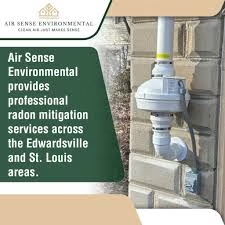
The most effective and EPA-endorsed method for reducing radon in homes with slab-on-grade or basement foundations is sub-slab depressurization (SSD). Here is how the system works:
- A suction point is created through the concrete slab or crawl space floor, accessing the aggregate layer or soil below.
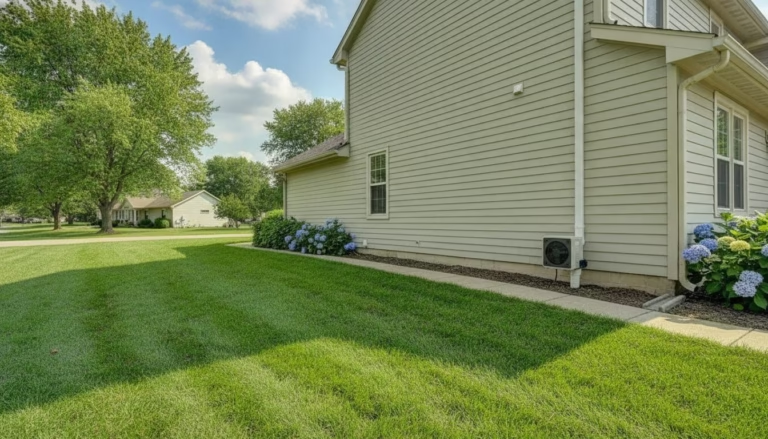
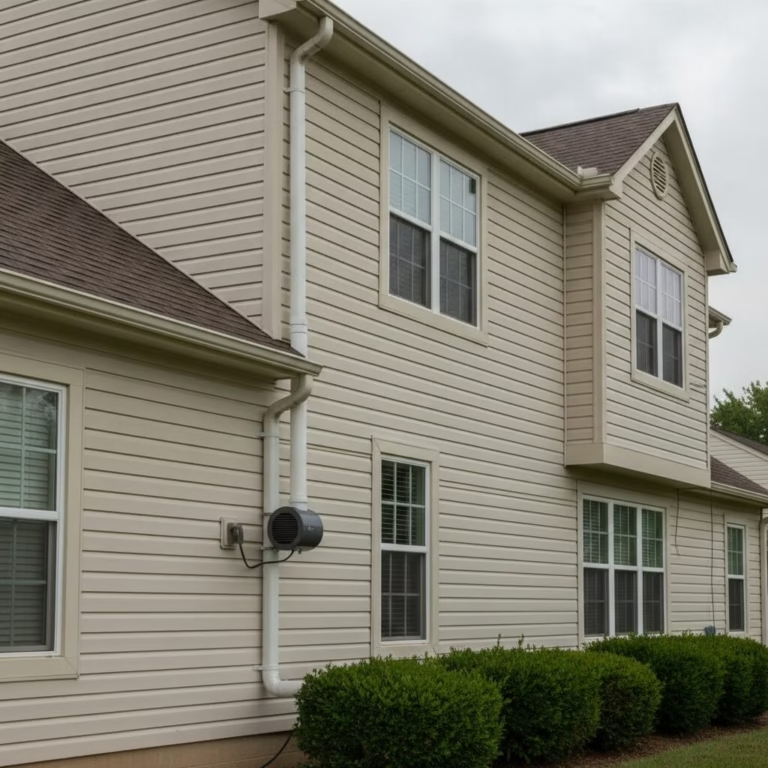
- A PVC pipe routes from the suction point through the interior of the home and exhausts above the roofline or to a safe exterior discharge point, away from windows, doors, and HVAC intakes.
- A continuously operating fan unit creates and maintains negative air pressure beneath the slab, drawing radon gas out before it can enter the living space.
- The depressurization field extends outward from the suction point, covering the area beneath the foundation.
- After installation, a post-mitigation radon test confirms the system is reducing radon to safe levels (the EPA action level is 4 pCi/L; the EPA target is below 2 pCi/L).
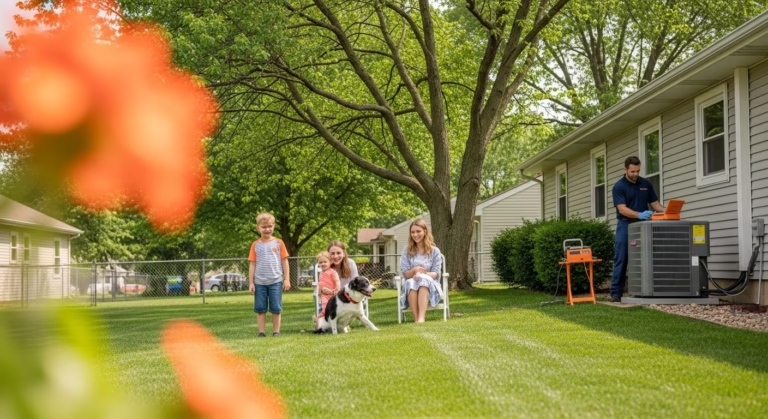
For most standard single-family homes in St. Louis, installation takes approximately 3 to 4 hours. The system operates silently around the clock and requires minimal maintenance, typically an annual visual inspection of the fan unit and manometer gauge to confirm the system is functioning.
Radon Testing: The Necessary First Step
Mitigation cannot be designed without first knowing your radon concentration and identifying how radon is entering your home. Air Sense Environmental provides licensed radon testing as a standalone service and as an integrated step in the mitigation process.
When radon testing is recommended:
- Before purchasing a home, radon is among the most common issues flagged in real estate inspections in the St. Louis area
- If your home has never been tested and has a basement, finished lower level, or slab foundation
- After any significant renovation affecting your foundation or basement floor
- Post-mitigation, to confirm the installed system is performing to specification
- Periodically in homes with known elevated readings (retesting every two years is commonly recommended)
Short-term tests (2-7 days) are appropriate for real estate transactions when time is a constraint. Long-term tests (90+ days) provide more statistically representative readings for non-time-sensitive assessments.
How Much Does Radon Mitigation Cost in St. Louis?
Radon mitigation costs in the St. Louis metro vary based on foundation type, the number of suction points required, pipe routing complexity, and whether interior or exterior routing is used. The range for a standard single-family home typically falls between $800 and $2,500, with most single-entry-point installations at the lower end of that range.
Factors that affect cost in the St. Louis area include:
- Foundation type, poured concrete slab, block wall basement, crawl space, and combination foundations each require different approaches
- Pipe routing, exterior routing is generally less invasive but subject to local code requirements; interior routing requires more labor
- Number of suction points, larger homes or homes with irregular sub-slab aggregate may require multiple suction points
- Existing penetrations, sumps, drains, and utility entries affect system design
Air Sense Environmental provides free in-home estimates before any work begins. You will know the full scope and cost before committing to installation. Because the company is owner-operated with Jake on every job, there are no subcontractor markups affecting the final price.
Choosing a Certified Radon Mitigation Contractor: What to Look For
Not every contractor who offers radon services carries the certifications that Missouri and Illinois require. When evaluating a radon mitigation contractor in St. Louis, verify the following before scheduling:
Certification and Licensing
- NRPP certification (National Radon Proficiency Program) or NEHA-NRPP certification, the two primary national credential bodies recognized by the EPA
- IEMA license (Illinois Emergency Management Agency), required for work in Illinois counties of the St. Louis metro (Madison, St. Clair, and surrounding counties)
- State of Missouri compliance, verify the contractor follows Missouri’s radon program guidelines through the Missouri Department of Health and Senior Services
Insurance and Accountability
- Contractor should carry general liability insurance and provide proof on request
- BBB accreditation or membership in professional associations (AARST, American Association of Radon Scientists and Technologists) reflects accountability standards
Post-Installation Testing
- Any reputable contractor should include or recommend a post-mitigation radon test following installation. A system installed without follow-up testing cannot be confirmed as effective.
Air Sense Environmental meets every one of these standards: NRPP-certified, IEMA-licensed (#RNM20232346), BBB-accredited with an A rating, and fully insured, with a post-installation test included as part of every mitigation project.
Does Radon Mitigation Really Work?
Yes, when installed correctly by a certified contractor, sub-slab depressurization systems are highly effective. The EPA and independent research consistently show that properly installed active mitigation systems reduce indoor radon levels by 50% to 99%, with the majority of installations achieving levels well below the 4 pCi/L action threshold.
Key performance factors:
- Active (fan-driven) systems consistently outperform passive systems. Passive systems rely on natural air pressure differentials that vary seasonally and may be insufficient in homes with tight construction.
- Professional installation ensures the suction point is positioned to maximize the depressurization field across the full slab footprint.
- Post-installation testing confirms performance, this step is non-negotiable for any legitimate mitigation project.
If radon levels remain elevated after an initial installation, the system can be evaluated for additional suction points, fan sizing adjustments, or supplemental sub-slab treatment. Air Sense Environmental addresses post-mitigation elevated readings as part of its service commitment.
Service Area: Greater St. Louis Metro
Air Sense Environmental serves residential and commercial properties throughout the greater St. Louis metropolitan area, including:
- Missouri: St. Louis City, St. Louis County, St. Charles County, Jefferson County, Franklin County
- Illinois: Madison County, St. Clair County, and surrounding bi-state communities
Whether you are in Clayton, Chesterfield, Ballwin, Kirkwood, O’Fallon, Belleville, or any surrounding community, Air Sense Environmental provides the same certified, owner-operated service on every project.
Why St. Louis Homeowners Choose Air Sense Environmental
With 135 five-star Google reviews, NRPP certification, IEMA licensure, and a BBB A rating, Air Sense Environmental brings a level of verified accountability that matters when you are dealing with a health-related service. Owner Jake handles every project personally, you are not dealing with a national franchise assigning subcontractors to your home.
Radon does not announce itself. It accumulates quietly, and its health effects emerge over years of exposure. Testing costs little. Mitigation, when needed, is a one-time investment in your family’s long-term health. If your St. Louis home has never been tested, or if a test revealed elevated levels. Air Sense Environmental is ready to help.
Call now for your free radon consultation. Serving St. Louis City and County, St. Charles, Jefferson, Franklin, Madison, and St. Clair counties.
Radon mitigation is a health and safety service. All testing and mitigation work by Air Sense Environmental is performed by NRPP-certified and IEMA-licensed professionals in accordance with EPA and state radon program guidelines.